
Postpartum Pilates
Rebuilding Core Strength After Pregnancy Without Risk
If you're a new mom dealing with a core that feels disconnected, a pelvic floor that isn't cooperating, or a visible gap down the center of your abdomen, you're experiencing what millions of postpartum women go through.
And the frustrating part is that most advice falls into two unhelpful camps:
"Give it time"or "Just do crunches."
Both are incomplete.
Rebuilding your body after pregnancy and birthing requires specific, guided movement that accounts for what happened to your muscles, connective tissue, and pelvic floor.
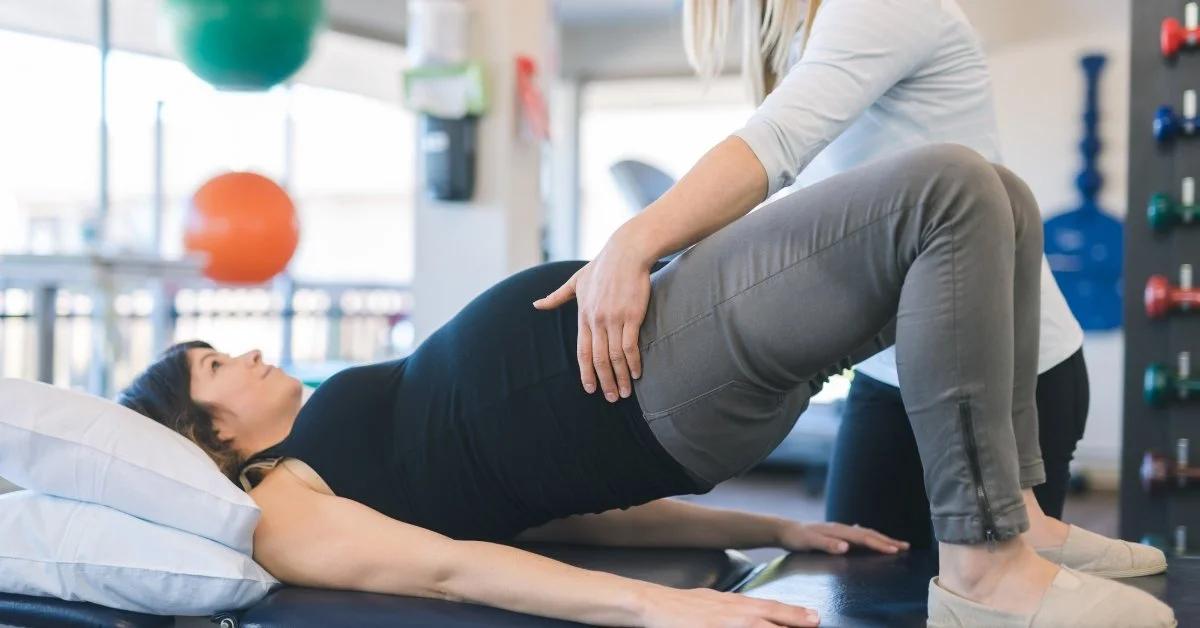
What Happens to Your Core During Pregnancy
During pregnancy, your abdominal muscles can separate down the middle to make room for your baby.
This is called diastasis recti (DR), and it happens to roughly two out of three women.
The important thing to understand is that this isn't just a muscle tear; the connective tissue between your abs has stretched and thinned. For years, the standard advice was to avoid crunches and sit‑ups completely because of fears they would increase pressure on that tissue.
Newer research, however, shows that when done with deep core control, small, progressive curl‑ups can actually narrow the gap between the abdominal muscles and improve function, rather than worsen it.
In other words, it’s not that flexion‑based exercises are “bad” for DR; it’s that they need to be introduced at the right time, with the right muscle recruitment, for the right body.
This is exactly what a skilled postnatal Pilates instructor assesses and teaches.
Why Pilates Works for Postpartum Recovery
Pilates starts with breathing and deep core activation, the exact muscles that need rebuilding after pregnancy, before progressing to anything more demanding. That makes it a natural fit for postnatal recovery.
A 2023 study published in BMC Women's Health found that postpartum women who followed a Pilates program saw a significant reduction in abdominal separation, decreased waist circumference, and improved core endurance. The women who didn't exercise saw no change.
The research confirms what postnatal specialists have seen for years: Pilates works for postpartum recovery when it's programmed correctly.
Your Pelvic Floor Also Needs Attention Too
Core recovery is only half the equation. Your pelvic floor muscles work together with your diaphragm, deep abdominals, and lower back.
Kegels alone miss that connection. Pilates trains your pelvic floor as part of every movement, not in isolation.
Every breath cue, every core engagement on the Reformer or Cadillac activates your pelvic floor alongside everything else.
A 2023 randomized controlled trial found that Pilates significantly reduced urinary incontinence and improved pelvic floor strength in postpartum women.
Left unaddressed, these issues can become chronic.
Why Private Sessions Matter for New Moms
Every postpartum body is different.
- Vaginal delivery versus C-section.
- Diastasis recti with pelvic floor involvement versus without.
- First baby versus third.
A group class can't account for these variables, and a YouTube video definitely can't.
In a private Pilates session, your instructor assesses your specific situation, checks for diastasis recti, identifies pelvic floor coordination issues, evaluates whether you can safely tolerate flexion‑based exercises, and builds a program that progresses at the pace your body dictates.
At Emerald City Pilates, Deborah Swan specializes in working with pregnant and postpartum bodies.
Deborah understands which movements to prioritize and which to avoid, and meets you with the kind of patience and clarity that makes rebuilding feel manageable.
When Should You Start?
We always recommend getting clearance from your OB or midwife before beginning. General timelines look like:
1. Vaginal delivery: typically cleared around 6 weeks postpartum
2. C-section: typically cleared around 12 weeks postpartum
The sooner you start working with someone who understands postnatal movement, the stronger the results.
Recovery within the first year consistently outperforms waiting longer.
Rebuild With Expert Guidance
If you're postpartum and ready to reconnect with your body, our New Client Special is a smart starting point, and you can save over $150!
What’s included:
- Complimentary 15-minute goal-setting call
- Three one-hour private Pilates sessions
- Personalized at-home exercises
- Full access to all studio equipment
You grew a human. Your recovery deserves the same level of care and expertise.
References
Kim, S.H., Lee, D.H., & Kim, Y.N. (2023). Effects of Pilates on inter-recti distance, thickness of rectus abdominis, waist circumference and abdominal muscle endurance in primiparous women. BMC Women's Health, 23(1), 626.
https://pubmed.ncbi.nlm.nih.gov/38008749
Ceylan, M., Aydin, M., & Kaplan, S. (2023). The effectiveness of Pilates exercises on postpartum urinary incontinence: A randomized controlled trial. Journal of Women's Health Physical Therapy, 47(3), 145–152.
https://doi.org/10.1097/JWH.0000000000000321
Bø, K., Nygaard, I., & Ellström Engh, M. (2025). Impact of postpartum exercise on pelvic floor disorders and diastasis recti abdominis: A systematic review and meta-analysis. British Journal of Sports Medicine, 59(8), 562-570.
https://doi.org/10.1136/bjsports-2024-108619
Lin, X., Lu, Y., & Zhang, L. (2024). Prevalence and risk factors of diastasis recti abdominis in the long-term postpartum: A cross-sectional study. Scientific Reports, 14, Article 76974.
https://doi.org/10.1038/s41598-024-76974-x
Wang, Y., Li, J., & Chen, H. (2026). Prevalence of symptomatic established rectus diastasis of parity in the first year postpartum: A longitudinal cohort study. Acta Obstetricia et Gynecologica Scandinavica, 105(1), 45-53.
